Car and Truck Repair Blog
Driving Green! Get Better Mileage with a Few Simple Driving Tips
Rising costs of gas and environmental concerns over fossil fuel consumption make getting great gas mileage more important than ever. Many of us take fuel efficiency into consideration when we buy new or used cars, but what about the cars we already own?
Don’t count your current vehicles out yet! While there isn’t much that can be done (apart from an engine overhaul) to make a significant impact on your current car’s MPG, there’s plenty you can do to raise it slightly. Added up over time, an improvement in .5 to 3 miles per gallon can make a big impact – on the environment, and on your wallet!
Some of these tips are common sense reminders, and some may not be things you had thought made a different to your car’s mileage. While taking one or two of the steps below may not have a significant impact, being energy efficient in all your driving behaviors can make a big difference over time.
Try it out! Driving green is actually quite simple.
Get rid of junk in the trunk. Haven’t yet gotten around to taking those winter or summer tires out of the trunk and into the garage? Are you hauling around a load of such-and-such you keep forgetting to drop off at the so-and-so? Every bit of weight your car carries around increases its fuel consumption slightly, and over time, the difference between getting 23.5 MPG and 24 MPG can equal quite a bit. So empty out the trunk and give your car’s engine a lighter load!
Keep tires inflated properly. Soft tires are one of the biggest culprits when it comes to making your vehicle’s engine work harder than it should. Added on to this, unevenly inflated tires can cause alignment troubles and uneven tire wearing. Your car will run better – and require less gas and maintenance – all around if you keep the tires inflated at their recommended levels.
Routine maintenance! We’ve said it before, but it’s true: routine auto maintenance can improve your vehicle’s performance and lifespan – and that includes its fuel efficiency. Dirty spark plugs and dirty air filters waste fuel; spark plugs and air filters are something our technicians check at each maintenance visit. Sludgy engine oil, transmission fluid and other fluids can also cause your engine to work harder than it needs to. The bottom line: a well maintained car is an efficient car!
Don’t let the engine idle. While some older model cars (i.e. “classic cars”) may benefit from having a warmed engine block, modern cars don’t need to “warm up” before they’re ready to go – even in the winter time. Unless it’s well below freezing, one or two minutes is plenty of time for the engine to warm up. Sitting in the car with the engine on for more than 60 seconds uses more fuel than it does to start the car – so keep the engine turned off unless you’re ready to go.
Go the speed limit. The faster your vehicle goes above the speed of 60 MPH, the less fuel efficient it becomes – that’s just math. Going well over the speed limit not only puts you and others on the road at more risk, but it also makes your car’s engine less efficient.
Speed up and slow down gradually. If you’ve ever carefully watched a professional auto racer, you might have noticed that they do their best to avoid slowing down and speeding up quickly. When going around sharp corners, they’ll slowly ease into the corners and accelerate out, reserving natural inertia to propel their vehicle.
Regular street drivers like us could take a lesson from racers by relying on our cars’ inertia to help keep it in motion, rather than constantly braking and punching the gas. By letting your car gradually slow down before a red light or stop sign, slowly accelerating back up to full speed at intersections and following far enough behind vehicles that braking isn’t necessary, you can significantly reduce the amount of gas your car uses. This style of driving is particularly important for city driving, which requires more acceleration and deceleration.
Fall is Here! Snow Tires & What Every Michigan Driver Should Know
The temperature outside is turning, and while most of us may be thinking about enjoying fall colors and picking out Halloween costumes, winter is just around the corner! As most of us know, winter in Michigan can be just as treacherous as it is beautiful. Dealing with snow and ice is especially a challenge for drivers and commuters, but there are a number of precautions drivers can take to make sure their wintertime driving is as safe as possible.
The first – and most important – of those precautions is to use snow tires! Different from summer and all weather tires, snow tires provide extra soft, sticky grip for icy and snowy roads during winter. They’re a must-have for every Michigan vehicle. How would you like to have the same confidence driving on snow and ice as you have driving in rain in your all weather tires?
Even a rear wheel drive car with 350hp can be sure footed in snow and ice, with the help of quality snow tires. Snow tires give drivers the traction – and confidence – to no longer have white knuckles when using the passing lane on bad roads, and to lead those 20 car chains on the ice-laden freeway rather than following.
As you check off your fall list, make sure you include readying your vehicle for winter with adequate snow tires. Have questions about snow tires? We’ve answered some common questions below; you can also stop by the shop and speak with one of our technicians. In addition to helping you pick out winter tires, we will store your summer tires for free during the winter, and likewise your snow tires in the summer, so you don’t have to lug them home and store them in your garage.
When should I have snow tires put on?
Ideally, before the first winter storm hits. Because Michigan weather isn’t always predictable, we recommend getting your vehicle ready with the right tires in late fall, early to mid November, at the latest. Try to avoid putting snow tires on too early, however, as driving on dry pavement will wear out snow tires’ traction much more quickly.
Do I really need snow tires, or are all weather tires okay to use?
No, when it comes to giving you the starting (and, more importantly – stopping) traction you need, all weather tires (AWT) just don’t cut it. All weather tires are great for rain and shine during the other three seasons, but your vehicle needs the grip of snow tires to perform safely on snow and ice.
My vehicle already has AWD. Do I really need snow tires too?
Yes, you really do. All-Wheel drive might be enough to get you going through slushy snow and black ice, but they won’t help you stop when it matters. Being able to stop quickly enough is critical in many winter driving situations, and the ten to thirty extra feet it takes you to stop without snow tires could mean the difference between a close call and a fatal accident. Here at the shop, we even put snow tires on our customer shuttle, in order to provide our customers the safest ride to and from work or home when their car is in the shop.
My vehicle is front/rear wheel drive. Is it okay to only use two snow tires?
Nope, it’s not. Having snow tires only on the tires which power your vehicle will give it imbalanced traction, and won’t provide the kind of stopping and starting power that having four balanced snow tires will. The stopping power and traction of a vehicle with only two snow tires is barely better than a vehicle with no snow tires at all – so double your investment and quadruple your safety.
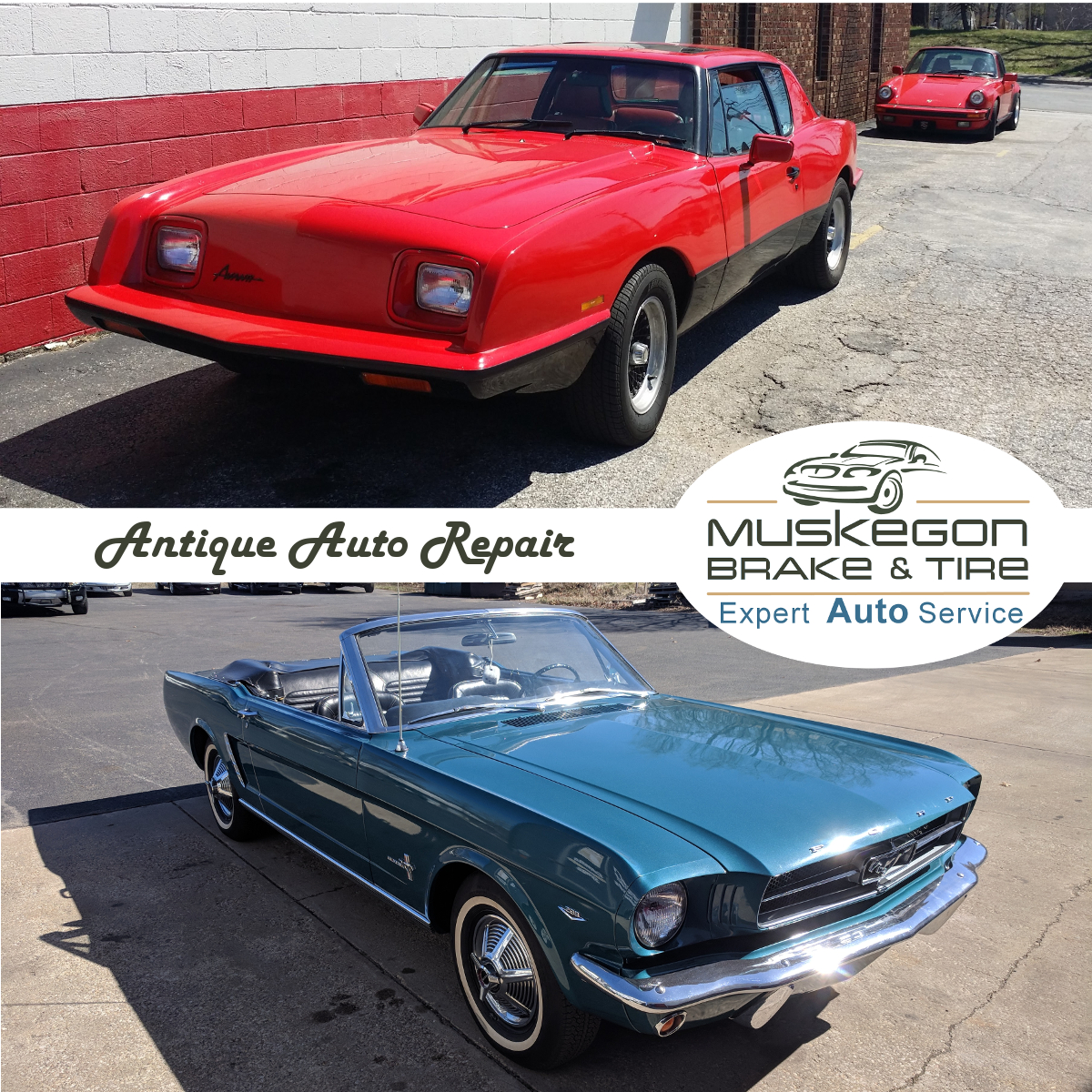
Even classic, sports and performance cars can be driven in the winter, with the help of quality snow tires. Drive your “cool” car in the winter when everyone else puts theirs away!
How often do I have to buy new snow tires?
If they’re not too worn down, snow tires can often be re-used for a second, and sometimes even third winter season. Use our general rule of thumb on tire tread depth to tell if your snow tires have enough tread yet, but remember that the more worn your snow tires are, the less stopping power they’ll provide. If you’re at all unsure about whether or not your snow tires are still good, have one of our technicians look them over before they’re installed, and we’ll give you our honest opinion. Remember: your summer tires will last longer if you switch to snow tires during the winter.
What brand of snow tire is best?
We carry plenty of great snow tire brands which offer a wide price range, but what’s most important is to have tires that are made specifically for snow, and for your vehicle. Not all snow tires are the same; the sticky compound in some tires is only 3/32 deep, while other manufactures mold the sticky compound through the complete tread-depth. If you make an appointment with one of our tire specialists, we can show you our inventory of Hankook, Cooper, Nokian, Michelin and other snow tires and help you choose which brand and type offer the best value for your vehicle. Our tire knowledgeable service advisors can educate you on the different brands and what they offer.
Why Pre-Purchase Inspections? Avoiding the Headache of Buying a Lemon
A pre-purchase inspection is a complete inspection of a used car a customer is considering buying. We strongly recommend pre-purchase inspections to all our customers who are considering buying used cars, and for good reason. No matter how good a car looks on the outside, a used car can have hidden problems that range from annoying to catastrophic – and most of the time, the only way to know for sure what you’re getting is for a technician to pop the hood and see for him or herself.
For example…
A while back, one of our customers had totaled their car and began looking for a new one. After discussing the benefits and pitfalls of buying new versus used, the customer decided to purchase used. They did not, however, opt for a pre-purchase inspection.
Soon enough, the customer brought the new-to-her car, complaining of a noise in the rear. We swapped cars with the customer and drove the car back to the shop. On the expressway, the noise is loud enough, but by the time the car is coming to a stop at a light, it sounds as if the car has been rear ended – but there’s no one behind the car. The noise turned out to be a bad differential, so we replaced the complete rear axle assembly (with a used assembly, since this is an older vehicle), and completed the repair.
Twenty five minutes after the customer has picked up her vehicle, she calls in again telling us that the car is low on power, and that he’s concerned she won’t be able to get to her next appointment. We pick the vehicle up again, give the customer a loaner car, and start the diagnostic process. The car runs fine on our standard and extended road test, and all online research shows no common problems or known related issues. Unable to locate the problem, we sent the vehicle home with the customer, only for her to discover the same problem twenty five minutes later. The car is brought back to our shop, and this time we take the car for an extended half an hour diagnostic drive with all diagnostic equipment running. We finally find the problem: the car needs a new transmission, plain and simple. There are, however, no remanufactured transmissions available for this particular vehicle, and the cost of rebuilding the transmission would cost more than the car is worth.
The customer wisely took all this information back to the business she had purchased the used car from and asked the dealer to buy the vehicle back. After a week of negotiations (and, we’re pretty sure, some hair pulling), the dealer finally agreed.
Having learned her lesson, the next used vehicle our customer looked at, she brought into the shop for a pre-purchase inspection. The second car, too, had major transmission problems – problems which would have cost more than it was worth to fix. The third vehicle was the charm; the third one she brought to us worked great for her business and personality, and the price was right. Since purchasing her “new” used vehicle, she has joined our Lifetime Oil Change Club – and the car has run flawlessly.
You can see why we recommend all our customers have a pre-purchase inspection performed on any vehicle they’re serious about buying. A level one pre-purchase inspection generally costs about $95; a level two pre-purchase inspection, which is slightly more, is ideal for classic, muscle, antique and exotic cars.
The moral of the story? If you plan on buying a used vehicle, the money that you’ll invest with us to have the vehicle thoroughly examined will save you enough time and potential major repair costs to be well worth the expense. Not to mention, you will have the peace of mind of knowing – not just hoping – that you made a great buy.
What Does It Mean to Be an AAA, ASE and Bosch Accredited Repair Shop?
At Muskegon Brake and Tire, we take our accreditations seriously – and many of our customers do, too. One of the most common questions auto owners ask when looking for a great repair shop is, “how do I know I can trust them?”
Our accreditations through organizations like AAA, ASE an Bosch are our way of answering that question. These organizations have set rigorous standards for quality in all aspects of car care, from customer service and technician training to part quality. When you visit a repair shop that has the ASE Blue Seal of Excellence, you can be rest assured that your repairs are in expert hands. Similarly, when you visit an AAA Approved Auto Repair facility, you can be sure that they offer only the best customer service.
But our accreditations aren’t just for show. We believe in offering only the best service possible, and we’ve worked diligently at meeting the strict criteria of all three of these well known programs to demonstrate our dedication.
AAA Approved Auto Repair
Members of AAA rely on this organization for accurate automotive information, resources and assistance – which includes recommendations on which auto repair shops offer the best service. In order to be a AAA Approved Auto Repair facility, shops must undergo a rigorous screening process which encompasses all aspects of service, from facility equipment and technician qualifications to customer service. A few of the qualities AAA ensures its approved facilities offer are guaranteed written estimates, return of replaced parts and a 12 month/12,000 mile parts and labor warranty. AAA Approved facilities must also demonstrate a minimum of 90% customer service satisfaction, based on a survey conducted by AAA itself.
There are currently only around 8,000 Approved Auto Repair facilities in North America today.
ASE Blue Seal of Excellence
The ASE Blue Seal of Excellence is a recognition awarded to automotive service shops that demonstrate a serious dedication to their automotive technicians’ training and certification. ASE, short for the National Institute of Automotive Service Excellence, is an independent automotive training and testing organization, and is the automotive repair industry’s gold standard for technician training. Automotive technicians seeking to become ASE certified must pass a rigorous set of tests and provide proof of substantial relevant work experience before achieving their certification. ASE offers technician training and certification in narrow specialties, ensuring the technician’s detailed knowledge of his or her areas of expertise.
In order to receive the Blue Seal of Excellence, an auto repair company must have at least 75% of its automotive technician staff performing diagnosis and repairs be ASE certified. Additionally, each service area the shop offers must be covered by at least one ASE certified technician who specializes in that area.
Less than one in 150 auto repair shops receive the Blue Seal of Excellence.
Bosch Service Center
The Bosch Service network is a group of high quality independent auto repair centers that have been rigorously evaluated in order to accepted as a recognized Bosch Service Center. As the largest OEM parts manufacturer in the world, Bosch places a particularly strong emphasis on part quality, and the organization itself offers high quality, cost-effective and fluids for top repair shops to use. Bosch also supplies its recognized service centers with top-notch diagnostic, equipment and training.
In order to be recognized as a Bosch Service Center, automotive repair shops must pass a rigorous evaluation and pass frequent ongoing inspections.
When it comes to quality repairs, part quality is extremely important. At Muskegon Brake and Tire, we routinely save our customers money by not only sourcing the best – and most cost-effective – part for the job, but by using quality parts which last longer and prevent breakdowns.
Routine Car Care Schedule – What Needs to be Done When?
You know that auto maintenance is important to both the longevity and safety of your vehicle. You’re ready to get on a regular maintenance schedule to make sure your car is receiving the care it needs to stay in top working condition. So…now what?
Keeping track of your car’s maintenance schedule can be tricky, especially on top of the rest of life, so we recommend keeping a pocketed notebook in the glovebox where you can keep track of all past and upcoming maintenance appointments. You can keep receipts for work done in the pockets for future reference. For those who are handy with Excel, a simple spreadsheet is another great way to keep track of auto maintenance work.
Keep in mind that knowing what maintenance has been performed on your vehicle – and at what intervals – is important information for your auto technicians to know, so it’s important to keep detailed records of past maintenance and repair work.
Armed with a little organization, here is a basic schedule we recommend for the average vehicle. Keep in mind that not every vehicle has the same maintenance interval requirements; when you bring your car in for maintenance, our technicians can look up your vehicle’s specific manufacturer recommendations for a more custom-tailored schedule.
Monthly checklist:
When it’s not time for an oil change, these tasks can easily be done at home, at the car wash or at the gas station.
Check all fluids. This includes engine oil, transmission fluid, power steering fluid and coolant (under the radiator cap). Fluids should be topped off (not too full), and should not be dark and sludgy.
Check tire pressure. Improperly inflated tires can cause all sorts of problems, from uneven tire wear and “splashy” unsafe driving to inefficient fuel usage. Tires should be checked each month to make sure they’re all at their recommended levels.
3 month checklist:
Engine tuning. Things like clogged fuel injectors and burnt spark plugs can hinder an engine’s fuel efficiency by up to 30% and put extra strain on engine components.
Oil change. How often oil changes need to be made depends on your vehicle’s mileage and manufacturer recommendations. Some modern vehicles can go as far as 7,000 in between oil changes. Check with your auto technician to find out what frequency is best for your car. If you’re not sure, every 3 months, or every 3,000 miles is a good rule of thumb.
Battery maintenance and cleaning. Battery posts and cables accrue dirt over time, causing corrosion and faulty connections, which can lead to inefficient functioning and even failed a start. Battery cables, posts and fluid should be checked along with oil changes.
Lighting. Car owners aren’t always aware when headlights or taillights go out. Similarly, road wear and grit can scratch headlights, making them too dim. Having a mechanic inspect these lights along with oil changes makes sure you haven’t missed any burnt bulbs.
6 month checklist:
Engine belt check. Engine belts, such as timing belts and serpentine belts, become stiff, cracked and worn over time; when these belts break, they can cause a major inconvenience at best, severe damage to other components at worst. Every six months is a good timeline for making sure belts are in good condition.
Air filters. Like people, engines need to breathe clean air. Dirty, clogged air filters make it more difficult for engines to get the clean oxygen they need, making them less fuel efficient. Similarly, cabin air filters need to be kept clean to ensure drivers and passengers have fresh, breathable air.
Change windshield wiper blades. Most windshield wiper blades become stiff and brittle after six months, so they should be swapped out for a new set to avoid the safety hazard of poor visibility.